

Employees

Engaging our employees
| Engaging our employees | ||||
|---|---|---|---|---|
| Focus | Strategic Goals | Aspects | Indicators | |
| • Employee engagement • Leadership and development • Health, safety and wellbeing • Employee benefits and compensation | • Improve employee wellness by reducing risk in three areas – cardio (fitness, weight), respiratory (smoking) and prevention (voluntary checkups), as measured on a health-risk index using 2015 as a baseline. • Maintain employee engagement above 80%. • Reduce work injury rate to no more than 3 injuries per 100 employees by 2020. • Reduce lost days due to injury rate to no more than 40 lost days per 100 employees by 2020. | • Employment • Occupational health and safety • Training and education | G4-LA1, G4-LA6, G4-LA10, G4-LA11 | |
Aligning our organization to meet sustainability goals
Aligning our organization to meet sustainability goals is important because it is our employees in all parts of Strauss Group that determine whether we will be successful or not. As a diverse group, operating in many countries and cultures, we must all share a common set of values and be inspired by a common vision and purpose. We align our organization by embedding our values, truly caring for our employees’ safety and wellbeing, investing in developing their capabilities and rewarding them for their tireless efforts. We value diversity and aim to create an inclusive workplace. This pays off for our business – statistics show that organizations with a high level of engagement report higher productivity and higher profitability – and it pays off for society, as, with more than 13,500 employees building a livelihood within the Strauss Group organization, the economic and social benefits for local communities are widespread.
Strategy to action
Employee engagement
We perform a global employee engagement survey every two years and the most recent global survey was conducted in 2013. Within a globally aligned framework, each Strauss Group company tailored an engagement survey to meet specific organizational needs while retaining a core that is common across the entire Group. The common elements included fifteen specific questions we asked of all our employees around the world, including questions on corporate responsibility and business ethics. Overall in 2013, we achieved an 84% response rate, with 5,634 responses out of a total 6,646 that were invited to participate. In general, across our markets, we found that our engagement scores ranged from 75% to 92% in different companies, a generally positive result by any standards, that leaves us, however, with aspirations to do even better.
The areas that our employees were most positive about include our performance in improving quality of life for our consumers, and being a socially responsible company. The top three results included showed that 90% or more of our employees believe that:
- Our products add value to our consumers’ quality of life
- Our company is socially responsible
- Our work environment is free from harassment.
The areas that our employees scored less well were in the areas of driving for personal excellence and leadership.
Leadership, development and training
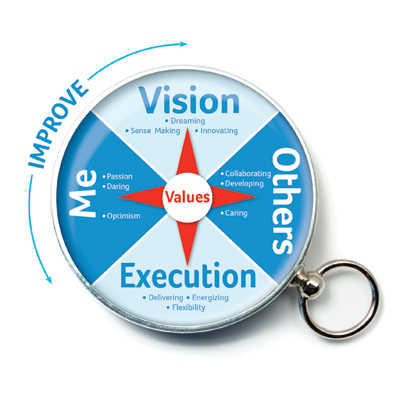 In 2013, we took the first steps towards implementing our new leadership and core competency MOVE model (“Me, Others, Vision, Execution”) in organizational processes throughout the Strauss Group companies. We expect that using the MOVE model will help us expand our leadership pipeline in coming years.
Training: We provide formal training in a variety of delivery formats to help employees improve their knowledge and skills as part of overall development plans identified during the annual performance evaluation. Training is targeted to meeting professional needs and personal development opportunities to help employees to do better what they do best. In 2013, we launched a computer-based Learning Management System for Strauss Israel office-based employees, covering CR-related topics including sexual harassment prevention, Code of Ethics, office safety, information security, and more. Following completion of the module, participants must confirm understanding in a short test. To date, 1,500 employees have completed the program. Overall in 2013, we invested over 190,000 hours of training for more than 10,000 employees at all levels.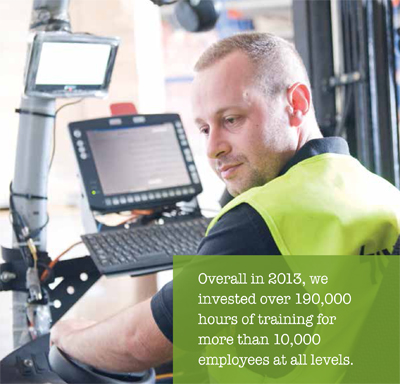
Job skills in an automated environment: Another area where we invested heavily to improve the capabilities of our employees is in the adaptation to an automated work environment. Automation requires different skills and capabilities from production operators and maintenance staff and the transition is by no means trivial. Rather than release employees as we introduce new technology, we trust the capability of our employees to embrace change and, with appropriate training, work with the manufacturing teams to deliver great results for our consumers.
Health, safety and wellbeing
We remain committed to providing a safe and healthy work environment and strive to continuously improve our performance. We employ trained Safety Officers in all our locations and they maintain an intensive pace of safety training and workshops in all parts of the business. In some locations, such as Israel, Romania and Poland, we have implemented the standard OHSAS 18001, a recognized quality standard in safety management. We conduct regular safety audits, identify hazards and take corrective action. We also strive to eliminate health risks to employees, and our safety program includes health-related education and training. At some locations, we employ a physician who provides medical consultations and advice for employees. Attention to safety also includes road safety for our staff involved in sales roles which require road travel, as well as instilling a culture of safe driving for those employees who travel to and from work in cars. In cases where we provide company vehicles, these are fitted with the highest standards of safety equipment and accessories. In 2013, we invested $1.85 million in equipment and tools in our operations in different countries to make our working environment safer for all our employees.
Expanding safety management: In 2013, we expanded our new safety program to our eight factories in Israel. The program is based on hands-on management involvement in safety with daily factory tours by managers on a rotating schedule. During the tours, managers observe production practices, engage in discussion with employees and note safety improvement action for follow up. This is a “gemba”-style practice, taken from Japanese principles of lean management. We also implemented a gemba standard work certification for managers to ensure alignment and correct use of the system. In 2013, 47 managers at our Achihud factory in Israel were certified and engage with employees to improve safety as a regular part of their work. We believe this approach has contributed to a significant improvement in our safety performance in 2013 in Strauss Israel of a 29% reduction in lost time injuries and a 17% reduction in lost time days.
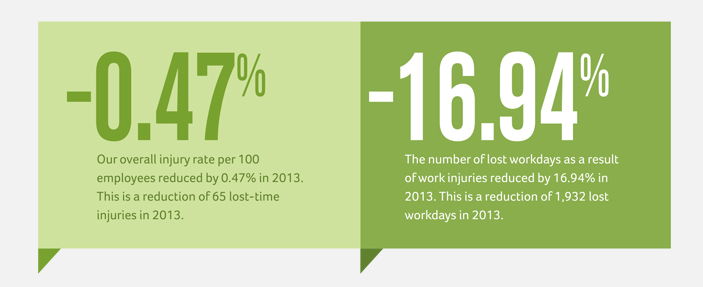
Our safety performance: Overall, our injury rate per 100 employees group-wide in 2013 was 4.46 injuries per 100 employees. Our strategic target is to reduce lost-time injuries to below 3 injuries per 100 employees. In 2013, our position moved slightly in the right direction, down from 4.93 in 2012 due to our ongoing investment in reducing safety risks and improving practice.
We regret to report that in 2013, one of our employees at our Brazil factory lost his life in a car accident on the way home from work.
Ergonomics: In 2013, we continued investing in improving workplace ergonomics to improve employee working conditions, prevent occupational hazards, and improve efficiency. We initiated a proactive program for ergonomics improvement that included extensive training and skills development for 25 individuals nominated as ergonomic specialists. We conducted risk assessment relating to ergonomics around our different sites and completed work station redesign along ergonomic principles at several locations.
Protecting employees through transitions
In 2013, we closed our coffee factory in Safed in northern Israel, after 60 years of operation. From the outset, we took a decision to ensure that the fifty people employed at the factory would be protected through the transition. In practice, we provided six months’ notice of the change to all employees, to provide employees with time to consider their future. Employees were offered alternative employment at other Strauss sites in Israel, including relocation assistance, and others were offered generous retirement plans. At the plant closure, all employees had been successfully transitioned with no forced redundancies.
Employee benefits and compensation
We aim to maintain compensation and benefits for all our employees that offer fair and competitive packages in line with local market norms in the different locations where we operate. In 2013, as every year, we monitor the way our compensation packages are performing in local economic conditions around the world and make adjustments to ensure we stay competitive.
Significant progress was made in 2013 in helping our employees in Strauss Israel to think ahead and plan for retirement. As a responsible employer, we want our employees to improve their lives in the future by planning ahead in an informed and considered way. A 2012 survey by the Israeli Central Bureau of Statistics showed that 36 percent of the Israeli population over age 20 is not covered by a pension plan and that of those that do have a plan, 62 percent do not understand the sum they will receive upon retir
ement or the way that sum will be calculated.
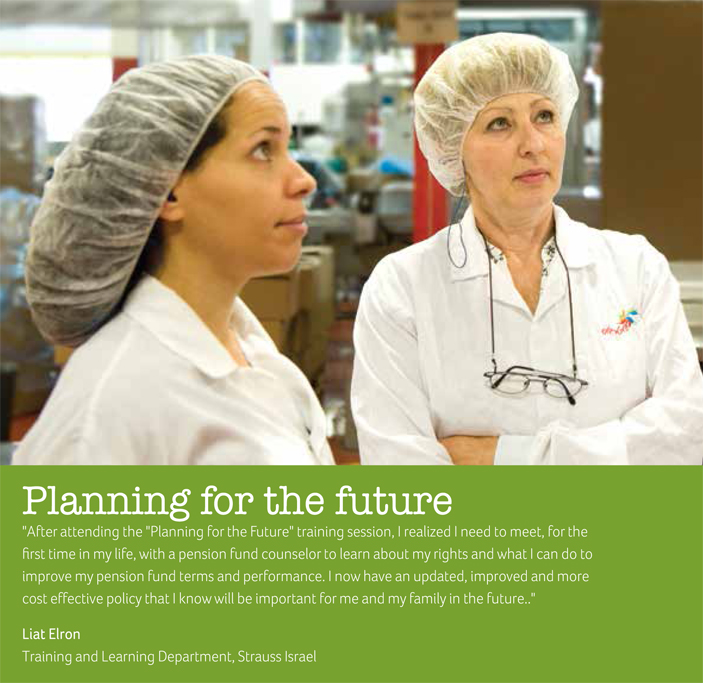
We aim to provide our employees with the best retirement plans available in the Israeli market. Also, we feel it is important that our employees understand how to get the best result from their individual plans according to their own personal circumstances, because regulation in Israel prevents employers influencing how employees determine future retirement plan schemes. Therefore, in 2013, we launched our “Planning for the Future” initiative to educate employees about their retirement provisions and provide them with tools to understand them better, monitor the financial aspects of the plans and take ownership for creating optimal pension plan savings for themselves and their families. The Planning for the Future program included training sessions run by our human resources department and external professionals supported with an offer of personal meetings for each employee with a pension counselor. At these meetings, employees were able to change the provisions of their pension plans and saving options to best meet their individual needs.
1,100 employees across seven Strauss Israel sites participated in training sessions and 270 employees (25% of employees trained) completed personal counseling sessions. This program continues in order to reach all Strauss Israel employees by the end of 2014.
test
