

A considerable decrease in the number of women in all managerial positions of publicly-traded companies in Israel.
The percentage of women in the workforce in Israel has not changed, but fewer women serve as chairpersons, CEO’s and hold management positions in top Israeli companies.
This morning we published the annual Catalyst Report – an index which examines the representation of women in the leading companies in Israel (TA 100 companies). A joint initiative of Strauss Group and the Israel Women’s Network, this Index is now published for the fourth consecutive year. A four-year examination of women’s representation in managements of publicly-traded companies points to an inconsistent growth in the number of women executives in the Israeli economy.
While women hold management positions in 83% of the TA-100 Index companies, the current Index, which pertains to the recently ended 2013, presents a clear decrease in the number of women executives in publicly-traded companies. Following two years of a growing percentage of women in management positions is a 3% drop in the number of women executives – from 34% in 2012 to 31% in 2013.
Women’s representation in senior management also decreased by 1% compared to last year – from 20% to 19%.
Representation of female CEO’s decreased by 0.4% from 7.9% in 2012 to 7.5% in 2013, and the percentage of women holding a chairman position in publicly-traded companies stood at merely 2% – compared to 3% in 2012 and 5% in 2011. Furthermore, there was a significant decrease in the percentage of companies with two women serving in management – 17% in 2013 compared to 30% in 2012.
A growing percentage of companies with more than one woman in management (43% in 2013 compared to 31% in 2012) was coupled with a growing percentage of women who hold a board seat (17.2% compared to 16.6%). However, the number of companies where women constitute 40% of senior management decreased by 5% – from 14 companies in 2012 to merely 9 in 2013.
Ofra Strauss, who initiated the Catalyst Index, said in view of these findings, “In a year which saw more women assuming key positions in the political and public sectors – it is the business sector that marks a setback in the representation of women in management positions in large companies. Studies clearly show that companies which incorporate more women in their managements become more successful and better connected to their customers. The incorporation of women in managements of publicly-traded companies is not only the order of the day, but it is also inevitable in the dynamic business environment and development of the state of Israel. The brewing conversation in our country about women’s ability to move forward and succeed has yet to be translated into substantive change in numbers.”
Dr. Galit Deshe, CEO of the Israel Women’s Network, “The front door to boards of directors in companies remains partially closed, and the women entering it are those who manage to break through. The growth process is slow, and this year even saw a setback in almost every parameter measured. An in-depth examination of the identity of women in senior management and boards of directors suggests that it is a very small group, and that the rising number does not emanate from an entry of more women into circles of influence, but from the fact that those women hold seats on several boards. Contrary to trends embedded in European countries in various forms, Israeli legislation does not work extensively to encourage organizations to expand the representation of women in their boards. All over the world we see various legal and regulatory solutions that increase countries’ responsibility for changing their gender balance, similar to processes taking place in Israeli government-owned corporations, and although this trend may not be the perfect solution, it could mark the beginning of a change, while placing the issue on the agenda.”
The complete Catalyst Index is attached hereto:
Main findings:
1. Main findings – the 2013 Catalyst Census on women’s representation in TA-100 companies:
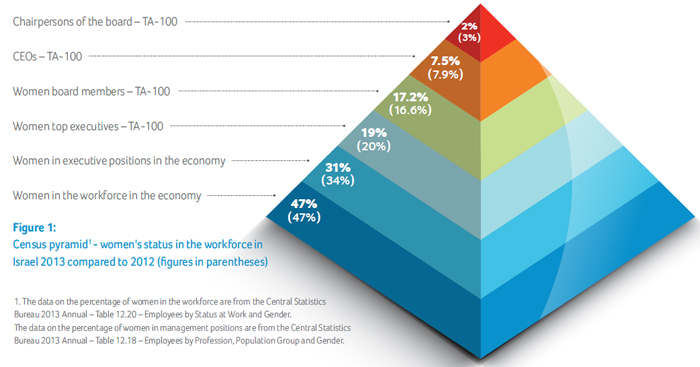
The census pyramid presents the summarized data for 2013. The figures for the year as well as the comparison to 2012 indicate that the situation in Israel as regards the status of women in the job market is far from equal or fair. There has been no change in the general participation of women in the Israeli labor market, which is 47%. Women account for almost half of the workforce, but their status in the labor market is unstable and has even grown weaker. Moreover, the situation of women in service and caregiving professions and their status as contract employees has not improved substantively in recent years. The data relating to the status and presence of women in senior management in TA-100 companies are also indicative of the status of women in executive positions in the economy as a whole, and of their status in the Israeli job marke
An in-depth examination of figures across four years of census point to inconsistent growth in the number of women executives in the Israeli economy.
2013 ranking of companies – 25% and more of women on the board of directors
In 2013 the number of companies with 25% and more of women holding board seats is 22, a slight increase compared to 2012 (20 companies) and low in relation to 2011 (26 companies).
Name | Percentage of women board members |
Azrieli Group Ltd. | 44.4% |
Strauss Group Ltd. | 41.7% |
Kerur Holdings Ltd. | 40.0% |
Formula Systems (1985) Ltd. | 40.0% |
Hadera Paper Ltd. | 37.5% |
Plasson Industries Ltd. | 33.3% |
Alony Hetz Properties and Investments Ltd. | 33.3% |
Evogene Ltd. | 33.3% |
Menora Mivtachim Holdings Ltd. | 33.3% |
Bank Hapoalim B.M. | 33.3% |
FIBI Holdings Ltd. | 28.6% |
Norstar Holdings Ltd. | 28.6% |
BIG Shopping Centers (2004) Ltd. | 28.6% |
Frutarom Industries Ltd. | 28.6% |
Perrigo Company Ltd. | 27.3% |
Ratio Oil Exploration LP | 25.0% |
Vilar International Ltd. | 25.0% |
Melisron Ltd. | 25.0% |
Property & Building Corp. | 25.0% |
Alrov Properties and Lodgings | 25.0% |
Alrov Israel | 25.0% |
Pluristem Therapeutics Inc. | 25.0% |
2013 ranking of companies with 25% and more of women in top executive positions
In 2013 the number of companies with 25% and more of women in top executive positions rose from 35 to 38.
Name | Percentage of women executive officers |
Compugen | 83% |
Kamada | 55% |
Ratio Oil Exploration LP | 55% |
Housing & Construction Holding Company Ltd. | 50% |
Union Bank of Israel Ltd. | 45% |
I.D.I. Insurance Co. Ltd. | 42% |
FIBI Holdings Ltd. | 40% |
Mivtach Shamir | 40% |
Africa Israel Investments Ltd. | 40% |
Matrix I.T. Ltd. | 36% |
Fox | 36% |
Kerur Holdings Ltd. | 33% |
Mizrahi Tefahot Bank Ltd. | 33% |
Electra Consumer Goods Ltd. | 33% |
Protalix | 33% |
Koor Industries Ltd. | 33% |
Migdal Insurance & Financial Holdings Ltd. | 30% |
Vilar International Ltd. | 29% |
Bank Leumi le-Israel B.M. | 29% |
Blue Square Real Estate | 29% |
Osem Investments Ltd. | 29% |
Clal Insurance Enterprises Holdings Ltd. | 28% |
Melisron Ltd. | 27% |
Discount | 27% |
Plasson Industries | 25% |
Norstar Holdings Ltd. | 25% |
Delek Group Ltd. | 25% |
Opko Health Inc. | 25% |
Cellcom Israel Ltd. | 25% |
Delek Automotive Systems Ltd. | 25% |
REIT 1 | 25% |
Rami Levy Chain Stores Hashikma Marketing 2006 Ltd. | 25% |
Tower Semiconductor Ltd. | 25% |
Partner Communications Ltd. | 25% |
ORL Oil Refineries Ltd. | 25% |
Brack Capital Properties NV | 25% |
LivePerson Inc. | 25% |
I.N.O.C. – Dead Sea LP | 25% |
International comparison – women in top executive positions
In Israel, 19% of the top executive positions in companies are filled by women (a 1% decrease compared to 2012, when the figure was 20%). This rate is slightly lower than the rate of women in executive positions in South Africa (22%) and higher than the rate in the USA, Canada and Australia.
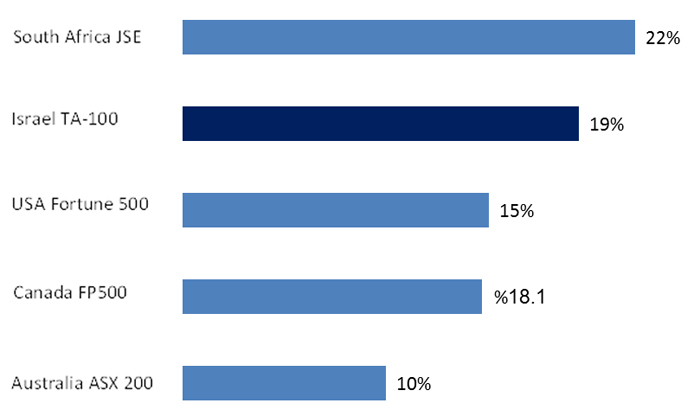
* Israel, USA and Canada data are for 2013. All other data is based on most recent publications from the Catalyst Website
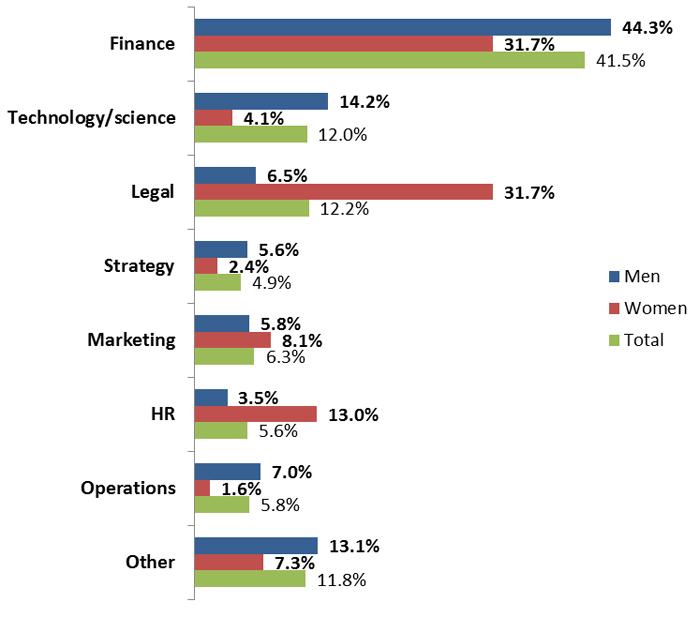
Gender comparison Senior Executives – occupation