

Diversity

Diversity in everything we do
| Diversity in everything we do | ||||
|---|---|---|---|---|
| Focus | Strategic Goals | Aspects | Indicators | |
| • Product diversity • Equal opportunity in employment • Supplier diversity in procurement practices • Advancing women in the community | • Diverse supplier spend (women-owned businesses) to reach at least 10% of total purchasing spend by 2020. • Achieve a rate of 50% of global management positions held by women by end 2020. • Offer product variants to meet specific health needs (obesity, diabetes, celiac, heart disease) in our top 10 selling brands by 2020. | • Diversity and equal opportunity • Equal remuneration for women and men • Local communities • Procurement practices | G4-LA12, G4-SO1, G4-EC9, G4-LA13 | |
Innovation and opportunity
Diversity is a value that is central to the way we work and an inclusive culture benefits all those we touch. It’s not just the people in our organization- diversity is integrated in every aspect of our business and sustainability strategy.
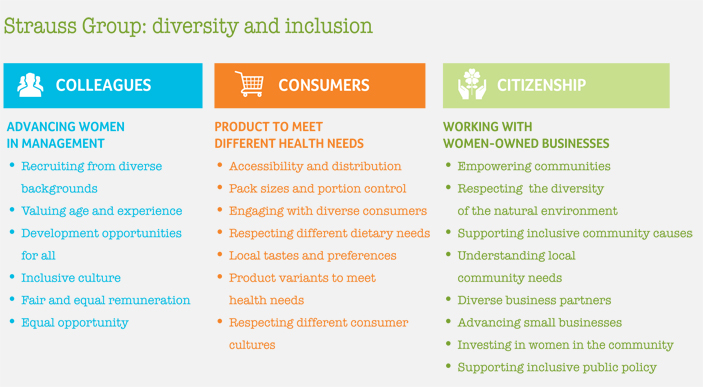
We aim to achieve positive impacts through a diverse and inclusive approach in our business. However, as diversity has such a broad scope, we have chosen to focus on three key areas that support our 2020 sustainability strategy:
- Colleagues: Advancing women in management
- Consumers: Developing more products to support diverse health and dietary needs
- Citizenship: Advancing supplier diversity, focusing on women-owned businesses and supporting the advancement of women in our communities.
According to Gallup Workplace Studies, organizations with inclusive cultures do better than those that are not inclusive, delivering 39% higher customer satisfaction, 22% greater productivity and 27% higher profitability. A healthy organization embraces diverse people and viewpoints.
Strategy into action
Delivering products for diverse consumer needs
We aim to make our products accessible to diverse populations and this includes providing solutions for people with specific religious, dietary or healthy lifestyle needs. We offer products which do not contain gluten, are suitable for diabetics, or are certified strictly kosher according to the highest religious standards. For example, in 2013, we converted our fresh salads factory in Karmiel to be entirely gluten-free and also removed gluten from our potato chips brand, Tapuchips. In both cases, we have received gluten free certifications and approvals, thereby broadening the number of consumers that can enjoy our products while making healthy lifestyle choices that are right for them.
In order to ensure our diverse communities of consumers are aware of the products we create for them, we employ different marketing platforms with campaigns that meet each population group wherever they are, and speak to them in their own language, respecting their values and culture.
Working with the Jewish orthodox community in Israel: In Israel, about 11 percent of consumers require strictly kosher certified products (Mehadrin), and this community is expected to reach 18 percent of the population in coming years. Strauss is the largest advertiser in the orthodox sector in Israel. Advertising to the orthodox community must observe specific methods and language, and use radio, billboards and newspapers as TV and internet advertising does not reach these consumers.
In 2013, we certified our main dairy factory in Israel according to the highest Mehadrin kosher standards, required by the Orthodox Jewish community. In fact, during the past three years, we have tripled the number of products available for those requiring Mehadrin certification under our Megadim brand.
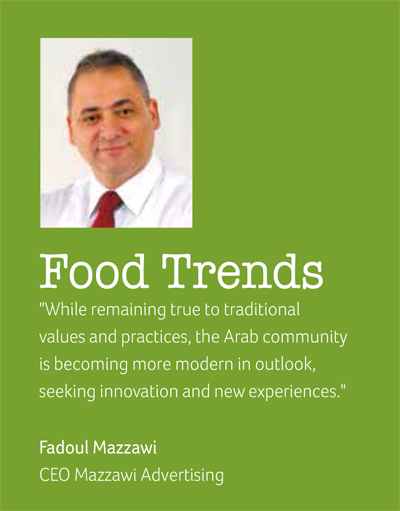 Working with the Arab community in Israel: Arab consumers make up one fifth of consumers in Israel. Advertising to the Arab community must take into account the specific preferences and language of our Arab consumers. We employ a specialist marketing agency to serve this community and ensure we meet their needs.
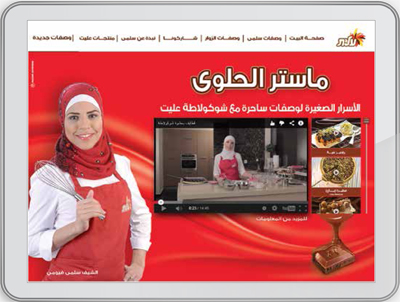
A recent marketing initiative for Arab women was based on the changing practice of using chocolate in family baking. In the Arab community, cookery skills are passed from mothers to daughters, including the traditional preparation of sweetmeats using cocoa powder rather than chocolate. In recent years Arab women are increasingly interested in expanding their horizons and considering other ways of preparing food. Salma Fiyumi from the Arab community in Israel was a finalist in the popular television show, Master Chef Israel. We engaged Salma to show Arab women how using chocolate instead of cocoa powder can upgrade their cakes and how adopting new cooking styles can refresh and even improve their traditional cuisine. The marketing initiative used a modern digital platform in line with the Arab community preference for online content rather than television, and included a mini-site with short cookery videos with Salma and recipe sharing among users. The campaign brought tens of thousands of views for the video recipes, and hundreds of women shared their recipes during the campaign.
Equal opportunity in employment
At Strauss Group, we maintain an inclusive culture which welcomes employees from all backgrounds and encourage diversity. A particular area of focus is ensuring that women have equal opportunity to join our company, and advance to the highest levels. We believe this has an important social and economic contribution as well as helping us manage our business more effectively.
In 2012, we launched a group-wide program with a visionary goal of reaching gender balance in our management levels with a target of 50 percent women in management by 2015. We created an infrastructure for implementing processes for an inclusive workplace, with an emphasis on women. These include setting goals and targets, establishing steering teams and raising awareness among all managers and employees in each of the five companies that form Strauss Group. Gender equality performance is also reflected in senior management compensation. We maintained our efforts in 2013.
Some of the specific areas we are addressing include ensuring the inclusion of women in our high potential management development program and examining our work processes with external recruitment agencies to apply principles for effective recruitment of women. Also in 2013, we analyzed our new hires, promotions and exits with an aim to establish correlation between gender, seniority and other aspects relating to women’s development in Strauss Group. This analysis helps us identify opportunities to improve gender balance.
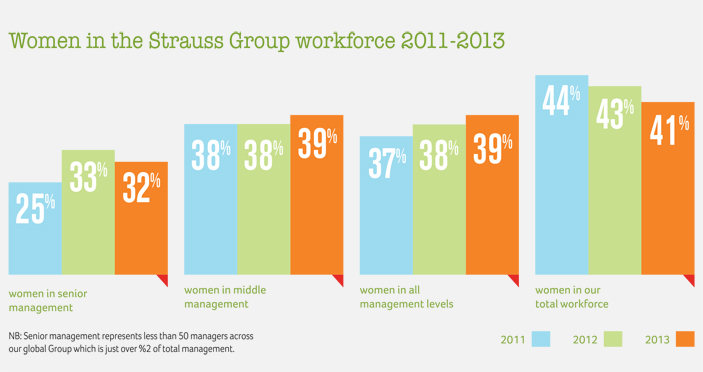
In the meantime, we are making progress, with women representing 41 percent of our global workforce and 39 percent of our management ranks in 2013.
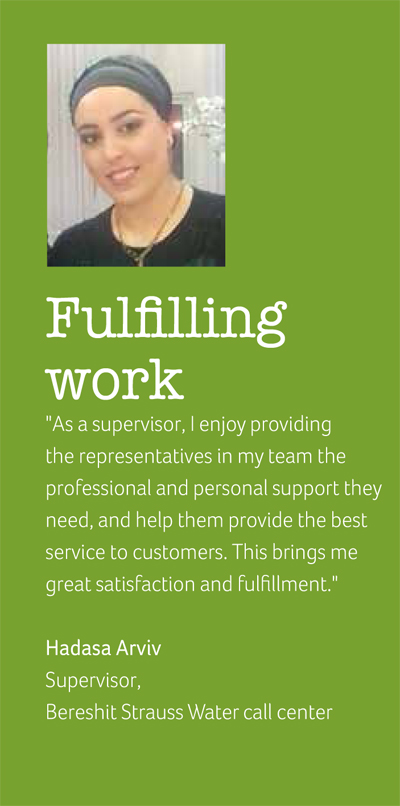 Strauss Water: A diverse employment opportunity: In 2013, Strauss Water established a new call center to handle increasing customer support demands as part of a growing business. An opportunity to create employment for a section of the population that has been underrepresented in Israeli workplaces was identified. Strauss Water engaged a dedicated unit of the Manpower Bereshit organization that provides outsourced call center services, employing women from the orthodox Jewish community in Israel. Orthodox women are under-represented in the workforce. Recent data indicates that 62% of orthodox women are employed, compared with over 80% of women in the general population. The orthodox religious framework means that unique needs must be addressed to accommodate religious and lifestyle choices of the orthodox community. Being responsive to the needs of orthodox women, we gain the benefits of our inclusive approach. Our outsourced call center now employs 65 women, responds to more than 2,000 customer queries each day and delivers a 91 percent satisfaction rate based on a customer survey in January 2014. Our experience shows that business needs can be in perfect alignment with corporate responsibility goals..
Sourcing from women-owned businesses
In 2013, we conducted an assessment covering over 2,500 suppliers of Strauss Israel, with an objective of understanding how we are doing in terms of procurement from women-owned businesses. We discovered that 9 percent of our suppliers are women-owned. It is our intention to expand our understanding of our engagement with women owned businesses at a global level, not just in Israel, and significantly increase the proportion of our purchasing spend with such companies.
Women-owned businesses are often also small businesses, and play a significant role in local community integration and empowerment. Supporting women-owned businesses creates a socio-economic ripple effect that creates healthier communities and improves the quality of life for many. In Israel, of the 400,000 registered small and medium sized businesses, 20% are women-owned compared with 33% in Europe and 44% in the U.S. Women-owned is defined as 51% or more ownership by women.
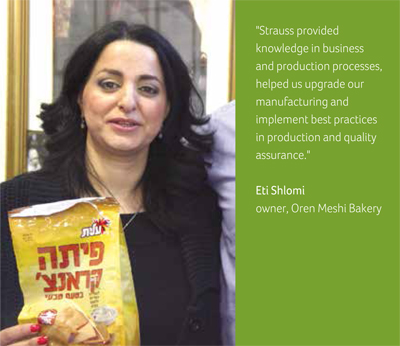 A new product from a woman owned bakery: In 2013, Strauss Israel launched a unique product, Pita Crunch, a new kind of baked pita chips. Pita Crunch is the result of a collaborative effort between Strauss’s Salty Snacks division and the Oren Meshi Bakery located in the southern periphery of Israel. The collaboration began in January 2013 when Strauss identified the Oren Meshi Bakery as a potential partner with experience in producing pita bread in a special process on a unique proprietary production line. The long term strategic partnership we established with Oren Meshi includes collaborative product development and knowledge sharing. Since starting to work with Strauss, Oren Meshi Bakery has more than doubled its workforce and secured business from new customers.
Advancing women and business in our community
In addition to advancing women as employees, and as partners, we also support the women’s business community and invest resources where they are most needed.
The Jasmine Forum for women business owners: In 2013, we launched the Jasmine Forum for women business owners that provides opportunities to learn from the knowledge and experience of women who lead globally successful businesses. The Forum organizes meetings for members to meet women business leaders from around the world, while creating a local community of women business owners to support each other in different ways. Strauss Group has partnered with Jasmine, the Association of Business Women in Israel, to promote women’s entrepreneurship and to help realize the economic potential of Jewish and Arab businesswomen in Israel. Ofra Strauss, Strauss Group Chairperson, serves as the President of Jasmine.
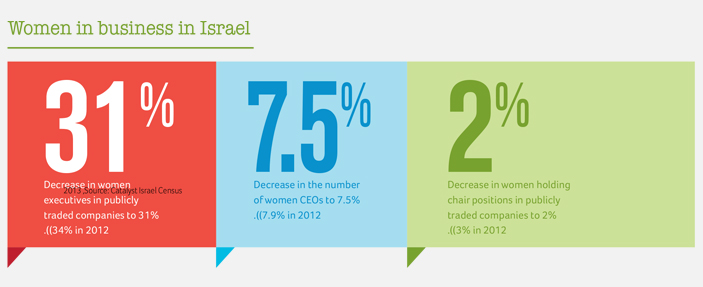
Catalyst partners: We continue to promote gender diversity through our partnership with Catalyst. Catalyst is a leading U.S.-based non-profit organization with a mission to expand opportunities for women and business. Catalyst’s Census Partners around the world work to track the representation of women on boards and senior management using Catalyst Census methodology. Strauss Group and the Israel Women’s Network have been Catalyst’s Census Partners in Israel since 2010. In 2013, we conducted the census for the fourth time, providing once again an up-to-date view of women in senior management and leadership positions in public companies traded in the TA-100 index of the Tel Aviv Stock Exchange.
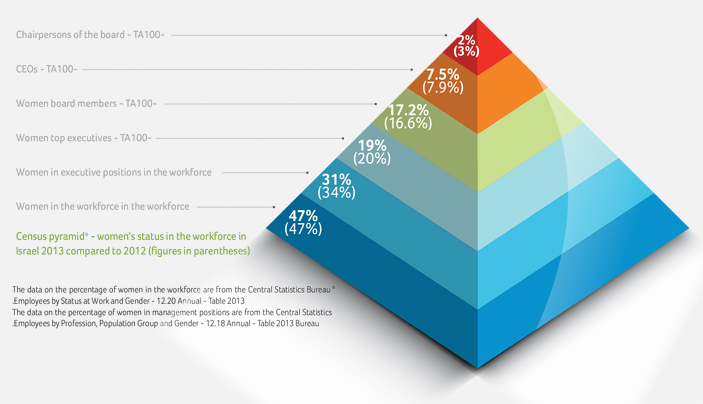
The 2013 census demonstrates that the Israeli business sector has still not fully embraced the benefits of advancing women in management positions. This is unfortunate because, as research has shown, correlations can be made between women in senior leadership positions and economic growth. In Israel, we have more work to do!
