

GRI Index
GRI Reporting Guidelines
The Global Reporting Initiative (GRI) is a global non-profit international organization which acts to increase the level of social and environmental reporting among companies throughout the world. The main way of assimilating this process is the use of the reporting framework which contains detailed guidelines for reporting on impacts and provides a consistent structure which thousands of companies around the world now use for sustainability reporting. For more information, please see: www.globalreporting.org.
This report complies with Application Level of the GRI G3.1 Framework. This has been confirmed by experts at the Global Reporting Initiative who checked our report in draft form and found it to be compliant with this reporting level.

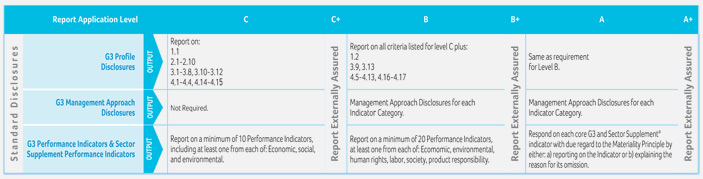
The different levels of the GRI framework relate to the level of transparency and disclosure in the report. Below is the table of the Application Levels of the GRI:
Profile Disclosures
GRI Ref. | Description | Report | Page No. | Comment |
1.1 | Statement from the most senior decision-maker | Fully | CEO Statement | |
1.2 | Description of key impacts, risks, and opportunities. | Fully | See our Annual Directors Report 2012, available at www.strauss-group.com | |
2.1 | Name of the organization. | Fully | About Strauss | |
2.2 | Primary brands, products, and/or services. | About Strauss | ||
2.3 | Operational structure of the organization, including main divisions, operating companies, subsidiaries, and joint ventures. | Fully | About Strauss. In addition, a full list of operating subsidiaries and joint ventures can be found in our Annual Report, 2012, Financial Statements, page 33. | |
2.4 | Location of organization’s headquarters. | Fully | About Strauss | |
2.5 | Number of countries where the organization operates, and names of countries with either major operations or that are specifically relevant to the sustainability issues covered in the report. | Fully | About Strauss | |
2.6 | Nature of ownership and legal form. | Fully | About Strauss | |
2.7 | Markets served (including geographic breakdown, sectors served, and types of customers/beneficiaries). | Fully | About Strauss | |
2.8 | Scale of the reporting organization. | Fully | About Strauss NB: All figures and sales are shown in U.S. $ calculated at the representative exchange rate of 31 December 2012: $1 = NIS 3.72 | |
2.9 | Significant changes during the reporting period regarding size, structure, or ownership. | Fully | This page | There were no significant changes in size, structure or ownership of the Group, beyond ongoing M&A activity as detailed in our Annual Report. However, in 2012, Strauss Group division Max Brenner transferred its Israeli Chocolate Bar shops to franchisees. |
2.10 | Awards received in the reporting period. | Fully | Best Place to Work: Israel | |
3.1 | Reporting period (e.g., fiscal/calendar year) for information provided. | Fully | About this Report | |
3.2 | Date of most recent previous report (if any). | Fully | About this Report | |
3.3 | Reporting cycle (annual, biennial, etc.) | Fully | About this Report | |
3.4 | Contact point for questions regarding the report or its contents. | Fully | ||
3.5 | Process for defining report content. | Fully | About this Report | |
3.6 | Boundary of the report (e.g., countries, divisions, subsidiaries, leased facilities, joint ventures, suppliers). See GRI Boundary Protocol for further guidance. | Fully | Notes to Data Collection | |
3.7 | State any specific limitations on the scope or boundary of the report (see completeness principle for explanation of scope). | Fully | About this Report | |
3.8 | Basis for reporting on joint ventures, subsidiaries, leased facilities, outsourced operations, and other entities that can significantly affect comparability from period to period and/or between organizations. | Fully | About this Report | |
3.9 | Data measurement techniques and the bases of calculations, including assumptions and techniques underlying estimations applied to the compilation of the Indicators and other information in the report. Explain any decisions not to apply, or to substantially diverge from, the GRI Indicator Protocols. | Fully | Notes to Data Collection | |
3.10 | Explanation of the effect of any re-statements of information provided in earlier reports, and the reasons for such re-statement e.g., mergers / acquisitions, change of base years/periods, nature of business, measurement methods). | Fully | No data has been restated. | |
3.11 | Significant changes from previous reporting periods in the scope, boundary, or measurement methods applied in the report. | Fully | There are no significant changes in scope, boundary or measurement methods. | |
3.12 | Table identifying the location of the Standard Disclosures in the report. | Fully | GRI Index | |
3.13 | Policy and current practice with regard to seeking external assurance for the report. | Fully | About this Report | |
4.1 | Governance structure of the organization, including committees under the highest governance body responsible for specific tasks, such as setting strategy or organizational oversight. | Fully | Governance Section and Annual Directors’ Report | |
4.2 | Indicate whether the Chair of the highest governance body is also an executive officer. | Fully | Governance Section | |
4.3 | For organizations that have a unitary board structure, state the number of members of the highest governance body that are independent and/or non-executive members. | Fully | Governance Section and Annual Directors’ Report | |
4.4 | Mechanisms for shareholders and employees to provide recommendations or direction to the highest governance body. | Fully | Governance Section | |
4.5 | Linkage between compensation for members of the highest governance body, senior managers, and executives (including departure arrangements), and the organization’s performance (including social and environmental performance). | Fully | Governance Section and Annual Directors’ Report | |
4.6 | Processes in place for the highest governance body to ensure conflicts of interest are avoided. | Fully | Governance Section | |
4.7 | Process for determining the qualifications and expertise of the members of the highest governance body for guiding the organization’s strategy on economic, environmental, and social topics. | Fully | Governance Section and Annual Directors’ Report | |
4.8 | Internally developed statements of mission or values, codes of conduct, and principles relevant to economic, environmental, and social performance and the status of their implementation. | Fully | Vision | |
4.9 | Procedures of the highest governance body for overseeing the organization’s identification and management of economic, environmental, and social performance, including relevant risks and opportunities, and adherence or compliance with internationally agreed standards, codes of conduct, and principles. | Fully | Governance Section | |
4.10 | Processes for evaluating the highest governance body’s own performance, particularly with respect to economic, environmental, and social performance. | Fully | Governance Section | |
4.11 | Explanation of whether and how the precautionary approach or principle is addressed by the organization. | Fully | Precautionary principle | |
4.12 | Externally developed economic, environmental, and social charters, principles, or other initiatives to which the organization subscribes or endorses. | Fully | UNGC | |
4.13 | Memberships in associations (such as industry associations) and/or national/international advocacy organizations in which the organization: * Has positions in governance bodies; * Participates in projects or committees; * Provides substantive funding beyond routine membership dues; or * Views membership as strategic. | Fully | Memberships | |
4.14 | List of stakeholder groups engaged by the organization. | Fully | Engaging stakeholders | |
4.15 | Basis for identification and selection of stakeholders with whom to engage. | Fully | Engaging Stakeholders | |
4.16 | Approaches to stakeholder engagement, including frequency of engagement by type and by stakeholder group. | Fully | Engaging Stakeholders | |
4.17 | Key topics and concerns that have been raised through stakeholder engagement, and how the organization has responded to those key topics and concerns, including through its reporting. | Fully | Stakeholder Roundtable |
